
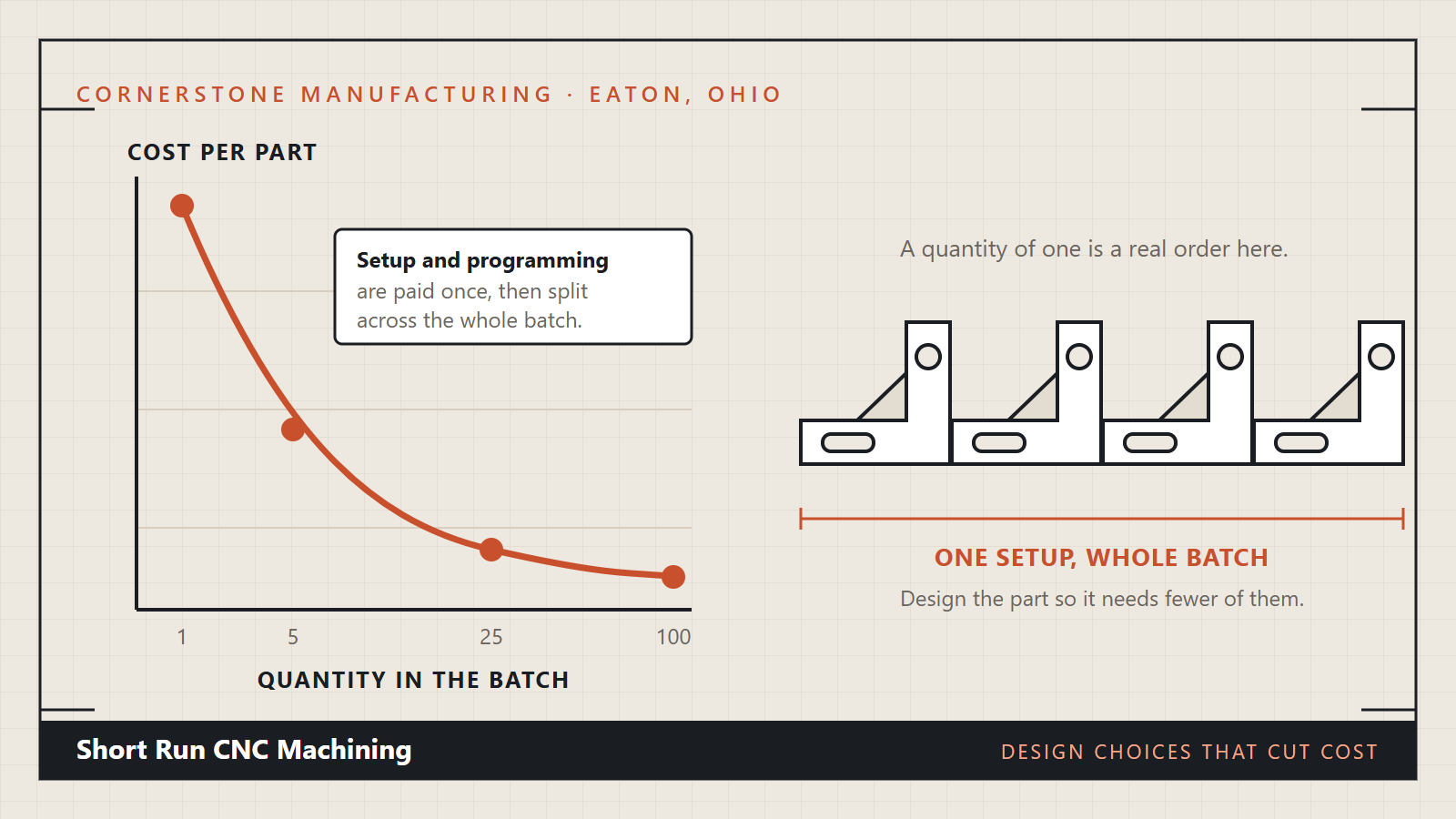
A short run is priced almost entirely by the work that happens before the first chip. Program the part once, build or set the fixture once, prove the first one once, and then split all of that across however many pieces follow. At a quantity of four hundred nobody notices. At a quantity of four it is most of the invoice.
The second thing driving the number is not in the geometry at all. It is how completely the drawing describes the part. NIST put a figure on that in 2020: an estimated $8.4 billion a year spent on engineers answering questions and creating additional drawing documentation, and $3.8 billion for machinists doing the same. Every one of those questions is a day a short run is not being made. And this is small-shop work by nature: NIST’s Manufacturing Extension Partnership worked with over 26,800 unique manufacturing clients across five fiscal years, with machine shops sitting fifth by impact among every industry it serves.
That leaves buyers with three recurring problems: a drawing written for volume production that gets quoted as a short run, a tolerance regime that adds inspection to every one of a handful of pieces, and a design that forces three setups when one would have done. All three are fixable on the drawing, before anyone quotes it.
Where the money actually goes on a low volume part
| Cost driver | On a run of 500 | On a run of 5 | What moves it |
|---|---|---|---|
| Programming | Spread thin, close to invisible | A real share of the price | Simpler geometry, fewer unique features |
| Fixturing | Dedicated fixture repays itself | Usually held in standard workholding | Designing the part with a clampable surface |
| Setups | Amortised across the batch | The single biggest lever | Features reachable from one orientation |
| Cutting time | Dominates the unit cost | Often a minority of it | Material choice, depth of pockets, tool reach |
| Inspection | Sampled across the run | Close to one hundred percent | Marking only the tolerances that matter |
| Material | Bought to size, little waste | Often a stock size with offcut | Designing to a standard bar or plate size |
Cut the setups before you cut anything else
Every setup costs time to fixture, time to touch off, and time to prove. On a run of five it also adds relocation error to every dimension that spans it. Removing one setup is usually worth more than any other change you can make to a low volume part.
Look at your model and ask which features force the part to be turned over. Frequently it is one hole, or a small pocket on the far face, put there for symmetry rather than for function. Moving it, opening it out, or reaching it from an angle instead can collapse two setups into one.
Specify the fit, not a tight number everywhere
A blanket tight tolerance is the most expensive sentence on a drawing, because it applies inspection effort to features that do not need it. A fit code does the opposite: it says precisely what one feature has to do and leaves everything else alone. ISO 286-1:2010, the ISO code system for tolerances on linear sizes, exists for exactly this. Calling a bore H7 tells a shop the feature has to locate a mating part, and it tells the inspector what to measure and how closely.
The rest of the drawing can sit on the general tolerance block. It is a stronger drawing and a cheaper part.
Design to what the machine already holds
A few habits reliably reduce a short-run price, and none of them compromise the part.
- Leave something to clamp. A part with no parallel surfaces and no flat to grip needs a fixture built for it. On a quantity of five that fixture may cost more than the parts.
- Use generous internal radii. A tight internal corner forces a small cutter, and a small cutter cuts slowly and deflects. Increasing an internal radius is often the single cheapest change on a milled part.
- Keep pockets shallow relative to their width. Deep narrow pockets need long thin tools, light cuts and patience.
- Design around standard stock. A part that starts from a common bar or plate size avoids paying for material you machine away.
- Standardise hole sizes and threads. Every unique size is another tool, and on a short run every tool change is paid for by very few parts.
- Say what the finish has to be, once. A surface roughness call on the two faces that seal is useful. The same call on every surface is not.
The challenges that make short runs go wrong
Some of what makes a low volume part expensive is not in the geometry at all.
- A drawing inherited from a production part. It carries tolerances and process notes that made sense at volume and simply add cost at five pieces.
- An unstated material condition. Alloy steel annealed and the same alloy heat treated to a hardness are different jobs. Leaving it off means the shop either asks, which costs a day, or assumes, which costs more.
- No indication of whether it repeats. A shop that knows a part will come back programs and fixtures it differently. A one-off treated as a repeat, or the reverse, prices wrong in both directions.
- Splitting the order across suppliers. Three shops each doing one setup means three sets of setup cost and three chances for the datum to move. On low volume, keeping the part in one place usually wins twice.
What not to bother optimising
Being straight about this matters. On a run of five, shaving cutting time is close to pointless: the tool is in the cut for a small fraction of the time the job occupies. Do not redesign a part to save thirty seconds of milling if the change costs an hour of programming.
Equally, do not chase the cheapest material if the expensive one machines faster and finishes better. On short runs the labour is the cost, and a free-machining alloy can cost less installed than a cheaper one that fights the tool.
How to decide what to change before you send the drawing
Take the model and count three things. How many orientations does the part need. How many dimensions genuinely have to be held closely. How many unique tools the features imply. Those three counts predict a short-run price better than the part’s size or its cutting time.
Then reduce whichever count is highest, and only that one. Chasing all three at once usually produces a part that is harder to use and no cheaper to make. If it is not obvious which one to attack, send the model as it is and ask. A shop that quotes its own work can tell you in a phone call which change is worth making, and which is not.
A quantity of one is a real order here, not a favour, and we will tell you before you commit which changes actually move the price. Send the model or the print through our quote request and it is reviewed by the people who will run it.
Frequently Asked Questions (FAQs)
What counts as a short run in CNC machining?
There is no fixed boundary, but the useful definition is any quantity where setup and programming still make up a meaningful share of the price per part. In practice that covers roughly one to a few hundred pieces, depending on how complex the part is.
Why is a single prototype so much more expensive than a part from a run?
Because the one part carries all of the programming, fixturing and first-off proving on its own. The cutting time is usually the smallest element. This is also why the price per part falls steeply over the first few dozen pieces and then flattens out.
Does a tighter tolerance always cost more?
On a short run it costs more twice over: the feature takes more care to produce, and it takes more effort to verify on every piece rather than on a sample. Mark the tolerance where the function needs it and leave the rest on the general tolerance block.
Should I pay for a dedicated fixture on a low quantity part?
Usually not, unless the part cannot be held in standard workholding or the order will repeat. A fixture is an investment that pays back over parts, so the question is how many parts it will see rather than how much it costs on its own.
What should I send with a short run enquiry?
A model or a dimensioned print, the material and its condition, the quantity, whether it repeats, the tolerances that actually matter, and any finish or coating. Those six things are usually enough to quote without a round of questions.